Today we celebrate the Memorial of Saint Boniface, who was born in 675 and died a martyr in 754. He is often called the Apostle of Germany, and yet he was an English Benedictine monk who left his homeland to evangelize the Germanic peoples. He was sent by the Pope. He preached tirelessly, founded monasteries and dioceses, reformed the Church, and brought many pagans to Christianity.
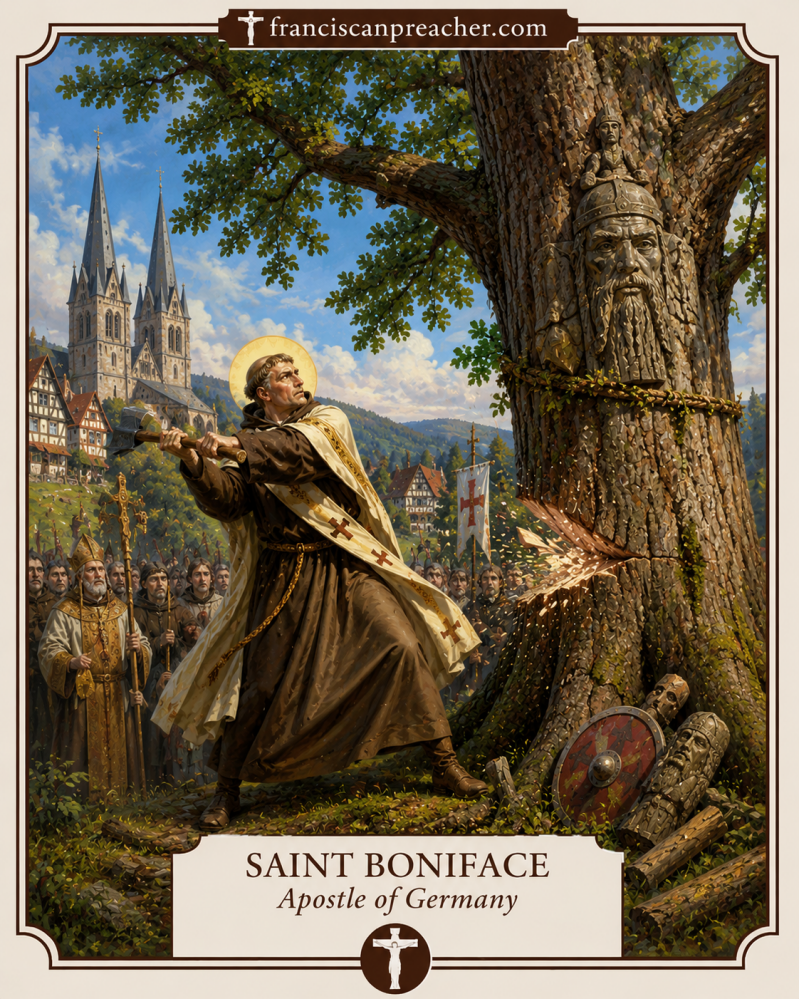
He is especially remembered for courageously cutting down the sacred Oak of Thor at Geismar to show that pagan gods had no power over Christ. Eventually, while preparing converts for Confirmation in Frisia, he and his companions were attacked and killed by raiders, dying as martyrs with the Gospel close at hand.
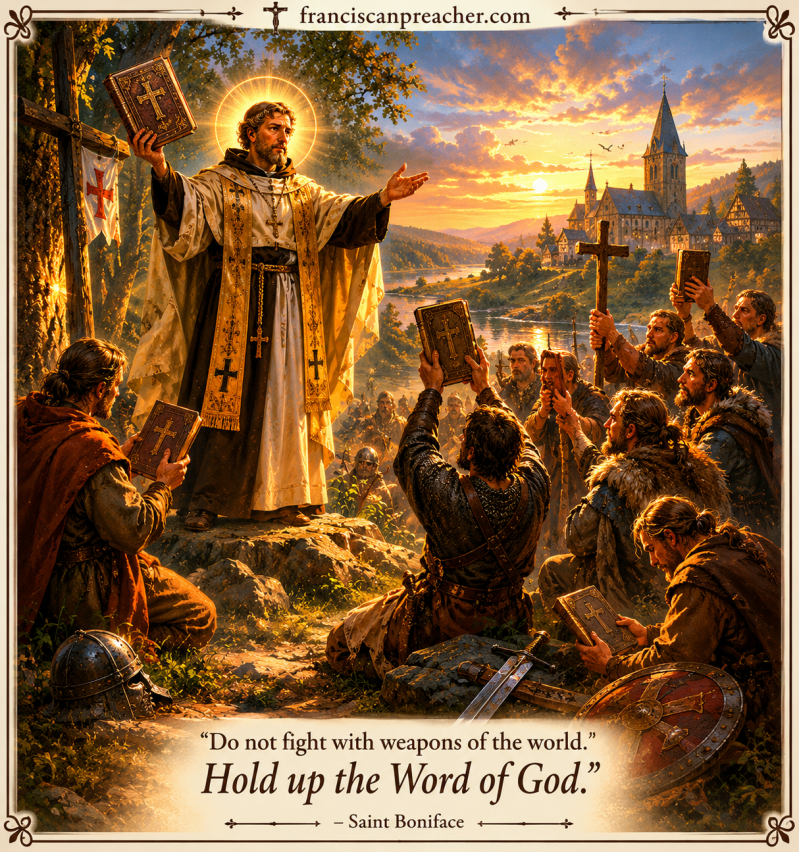
A lesser-known story about Saint Boniface is that shortly before his martyrdom, he reportedly instructed his companions not to fight back violently against their attackers. Instead of defending themselves with weapons, they held up sacred books and entrusted themselves to God. After his death, his blood-stained Gospel book was preserved, and some marks on it were long believed to have come from the fatal blows that struck him. It became a powerful symbol that Boniface died protecting not himself, but the Word of God.
So we can ask ourselves: how do we defend the Word of God in our lives? How do we protect it? By trying to live it, by passing it on to others, by reverencing it. For it is the Word not of man, but of God.
Saint Boniface therefore connects beautifully to the two readings that are given to us for his memorial. One is from the Book of Acts, and the other from the Gospel of John.
In Acts, Saint Paul says: “I was not disobedient to the heavenly vision” (Acts 26:19). And he goes on to describe to King Agrippa that he proclaimed the Gospel and preached the need to repent and turn to God, first to those in Damascus and in Jerusalem and throughout the whole country of Judea, and then to the Gentiles.
And so Saint Paul also preached not only the Gospel and repentance, but what does he say? He says: “to repent and turn to God, and to do works giving evidence of repentance” (Acts 26:20). See, these people who say that works are not needed — it flies in the face of Sacred Scripture and of what is logical and reasonable. You cannot say you love God and then continue sinning as if He does not really exist. It does not make sense. Now, we fall. But there is a difference between weakness and a persistence in sin as though God were irrelevant.
This preaching throughout the countries describes Boniface perfectly. He left comfort and security behind to preach repentance and Christ to foreign lands. He left England and went to Germany. And like Paul, he endured opposition and threats because he believed the Gospel had to reach all peoples.
Finally, in the Gospel, Jesus says: “A good shepherd lays down his life for the sheep” (John 10:11). And Boniface fulfilled this literally. He was not a hired man who fled danger, but a true shepherd who remained with his flock even unto death.
Christ also says: “I have other sheep that do not belong to this fold” (John 10:16). And Boniface spent his life gathering those other sheep into the one flock of Christ.
And so we too are encouraged to reach out to that person who is having a difficult time with their faith, to try to do our best to be there for those who have questions. And if we do not have the answers, that is okay. But we can search together for the answers.
Jesus said: “Seek and you will find” (Matthew 7:7). “Knock and the door will be opened to you” (Matthew 7:7). “Ask and it will be given to you” (Matthew 7:7).
So my brothers and sisters, delving deeper into the Word of God and the understanding of the Church regarding that Word will give us clarity and will give us some kind of answer. And yet, we cannot forget that this Good Shepherd remains a mystery, for He is beyond our imagination, beyond what reason alone can explain to us, although He Himself has revealed Himself to us and to many others, because He is the good and loving Shepherd.
Saint Boniface, Saint Paul, all the angels and saints, Mother and Queen of Martyrs, pray for us who have recourse to thee.
In the name of the Father, and of the Son, and of the Holy Spirit. Amen.
Lectionary: 577
Below are the readings suggested for today's Memorial. However, readings for the Memorial may also be taken from the Common of Martyrs, #713-718 or the Common of Pastors: For Missionaries, #719-724.
Reading 1
Paul said:
"King Agrippa, I was not disobedient to the heavenly vision.
On the contrary, first to those in Damascus and in Jerusalem
and throughout the whole country of Judea,
and then to the Gentiles,
I preached the need to repent and turn to God,
and to do works giving evidence of repentance.
That is why the Jews seized me when I was in the temple
and tried to kill me.
But I have enjoyed God's help to this very day,
and so I stand here testifying to small and great alike,
saying nothing different from what the prophets and Moses foretold,
that the Messiah must suffer and that,
as the first to rise from the dead,
he would proclaim light both to our people and to the Gentiles."
Jesus said:
"I am the good shepherd.
A good shepherd lays down his life for the sheep.
A hired man, who is not a shepherd
and whose sheep are not his own,
sees a wolf coming and leaves the sheep and runs away,
and the wolf catches and scatters them.
This is because he works for pay and has no concern for the sheep.
I am the good shepherd,
and I know mine and mine know me,
just as the Father knows me and I know the Father;
and I will lay down my life for the sheep.
I have other sheep that do not belong to this fold.
These also I must lead, and they will hear my voice,
and there will be one flock, one shepherd."
Add comment
Comments