My dear friends, peace be with you. In today's Word of God, on this 33rd Friday in Ordinary Time, we are being challenged by our Lord to examine our interior state. Both in the first reading from the Book of Revelation that comes to us from Saint John and in the Gospel of Luke, we have beautiful reflections and insights on what is most important to God in terms of the way we build our relationship with him. Does he want just exterior beauty, to look after ourselves exteriorly, or is he more interested in what's happening on the inside of the heart?
And so, in the first reading from the Book of Revelation, we see Saint John, who hears a voice from heaven saying to him, “Take and swallow it” (Revelation 10:9), in reference to the scroll, the Word of God. And then the voice goes on to say, “It will turn your stomach sour, but in your mouth it will taste as sweet as honey” (Revelation 10:9). What's the point being made here for our reflection? That the Word of God is sweet when it consoles us, when it affirms us in our faith, but it can become bitter when it challenges us to change our lives, to make difficult decisions. Saint John must first swallow the scroll before being sent to prophesy. This is a powerful image of the Christian vocation, particularly for those who are entrusted with preaching. We cannot simply communicate God's Word intellectually. We must first allow it to enter our hearts and our lives. We have to try to live it, to confront our own weaknesses, and to allow it to transform our lives. Then we realize that the Gospel is both a consolation and a demanding responsibility.
Having received God's Word, Saint John is commissioned to proclaim it to the nations. So too, we who hear God's Word every Sunday Mass, perhaps even during the week, hopefully when we pray we even pray with the Word of God and we allow it to speak to us, to read it, to savor it, to dwell on it, to let it penetrate our hearts, and then we go out into the world, and we're able to joyfully communicate the beautiful truths that are contained within and which have shaped our own hearts. And that's the beautiful grace that we are speaking not from merely an intellectual stance, but from the very depths of our transformed being.
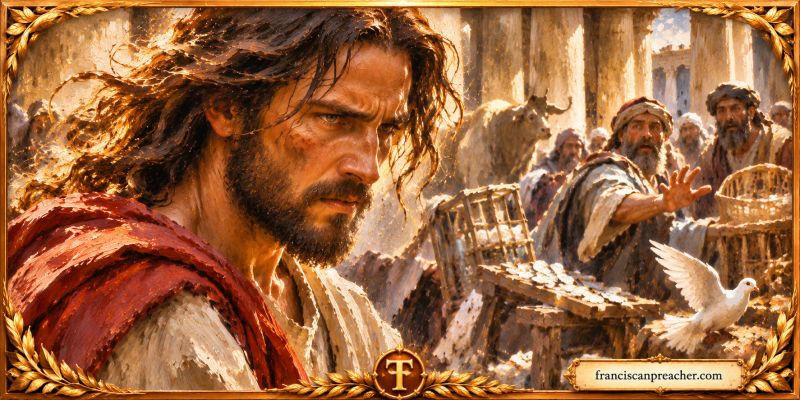
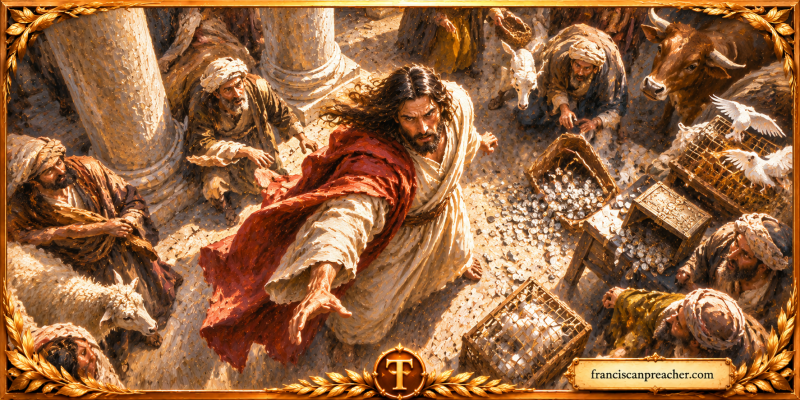
In the Gospel, Jesus says as he cleanses the temple, “My house shall be a house of prayer, but you made it a den of thieves” (Luke 19:46). Jesus does not cleanse the temple because he rejects worship, but because he desires to restore worship to its true purpose: communion with God. Unfortunately, the temple had become a place where commercial interests were interfering with its sacred purpose. Jesus' actions challenge us to examine the temples of our own hearts.
My brothers and sisters, we can have much to say about our local church, the building within which we meet, the community we try to build therein, the central location where we gather to be with the Lord who resides in our Blessed Sacrament tabernacles around the world. We can have much to say about the Vatican, about what's going on with the Church, with the Pope, but what's important, and what our Lord wishes to drive home, is that Jesus is challenging us to examine the temples of our own hearts. What have we allowed to occupy the space therein that belongs to God? Our distractions, ambitions, attachments, even the compromises that we make can gradually displace prayer and genuine devotion.
Saint Anthony once went up to Saint Francis. Saint Anthony, who was very learned, very wise, and very instructed in the theological world, wanted to teach theology to the friars. And so, with a bit of trepidation, he went to Francis to ask for permission. And Francis said, “Teach them, teach them theology, just do not forget the spirit of prayer and devotion.” In other words, so many things can be distractions, even good things, from that one thing that Jesus calls necessary: prayer. Saint Francis, in his Earlier Rule, in the 22nd chapter, says, “Let us always make a home and a dwelling place there for him who is the Lord God Almighty, Father, Son, and Holy Spirit.” See, Francis understood that God desires to dwell not only in sacred buildings but within the human heart. The cleansing of the temple must therefore begin with ourselves. And before we can proclaim God's Word convincingly, we must allow that same Word to purify our intentions, our priorities, and our desires.
Add comment
Comments