Today we celebrate the beautiful memorial of perhaps one of the greatest saints in the history of the Church, Saint Ignatius of Loyola, founder of the Society of Jesus, better known as the Jesuits. His life demonstrates that holiness is not achieved by extraordinary talent, but by allowing Christ to completely redirect our lives, to set us apart. And this is what holiness means: being set apart, consecrated to the service of God.

My dear friends, Saint Ignatius was born in 1491 in the Basque region of northern Spain into a noble family. As a young man, he dreamed not so much of becoming a saint, but of becoming a famous knight. Does that remind you of anyone? In a bit we'll get into the comparisons with Saint Francis of Assisi.
He loved being honoured, military glory, fine clothes, and his romantic adventures. In many ways, he lived for himself.
But everything changed.
On the 20th of May, 1521, during the Battle of Pamplona, a French cannonball shattered his leg.
During the long months of recovery, there were no books of chivalry available to entertain him. Instead, he was given two books that would change his life: The Life of Christ by Ludolf of Saxony, and The Golden Legend, a collection of the lives of the saints.
As he read, something remarkable happened. He noticed that dreams of worldly glory left him empty, while thoughts of imitating Christ and the saints filled him with lasting peace. This simple observation became the beginning of what he later called the discernment of spirits, one of his greatest contributions to Christian spirituality.
After recovering, Ignatius laid down his sword before the Blessed Virgin at the shrine of Montserrat, exchanged his noble clothing for that of a pilgrim, and spent nearly a year in prayer and penance at Manresa, where many of the insights that would later become the Spiritual Exercises were born.
Eventually, Saint Ignatius gathered companions while studying in Paris, among them the great Saint Francis Xavier, who remains incorrupt today in Goa, a great missionary who converted thousands and baptized hundreds of thousands, and Saint Peter Faber.
Together they vowed poverty, chastity, and complete availability for the service of Christ and His Church.
In 1540, Pope Paul III officially approved their new religious order.
Notice the name they chose: not the Society of Ignatius, not the Company of Loyola, but the Society of Jesus. The Latin title is Societas Iesu. Ignatius deliberately wanted Christ, not himself, to be the centre.
They understood themselves to be companions of Jesus, soldiers under the banner of Christ, completely at the disposal of the Holy Father for whatever mission the Church required.
Their motto became what our motto should be: Ad Maiorem Dei Gloriam—For the Greater Glory of God. Everything, no matter how ordinary, was to be directed toward God's glory.
My dear friends, here at franciscanpreacher.com, we like to emphasize how Franciscan spirituality enters into the lives of many of the saints whom he preceded. And although separated by almost three centuries, there are striking similarities between these two saints.
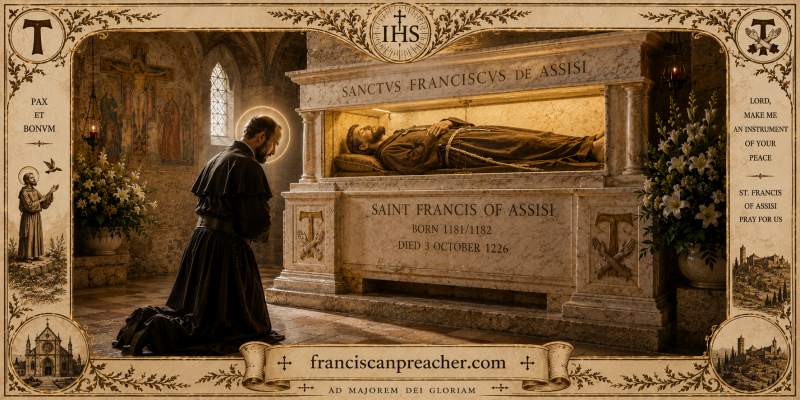
They both began as ambitious young noblemen. They both dreamed of military glory. They both had their days of partying. They both experienced a dramatic conversion after illness or suffering.
Notice how illness or suffering is not always tragic, but God uses it to lead someone to a better place.
Both renounced wealth and status to follow Christ completely. Both made pilgrimages, embraced poverty, and sought only the will of God after their conversion.
There are also important differences.
Saint Francis was called primarily to rebuild the Church through radical evangelical poverty, fraternity, and joyful witness.
Saint Ignatius was called to renew the Church through education, missionary activity, careful discernment, and obedience during one of the most turbulent periods in Christian history, the Protestant Reformation.
Yet Saint Francis deeply influenced Ignatius. Of course, he came before him.
While studying and travelling through Italy, Ignatius spent considerable time in Assisi. He prayed in places sanctified by Francis and absorbed something of the Franciscan spirit of complete surrender to Christ.
He learned from the humility of Saint Francis and from his desire to imitate Christ quite literally and perfectly.
Both these saints insisted that love must express itself in concrete action. It's not enough for us merely to talk about love and the beauty of charity in the eyes of God.
One of Saint Ignatius's most famous sayings could easily have come from Saint Francis: "Love ought to manifest itself more by deeds than by words." (Saint Ignatius of Loyola)
Likewise, Saint Francis's desire to observe the Holy Gospel of our Lord Jesus Christ finds a beautiful echo in Ignatius's insistence that every decision be measured against Christ Himself.
In today's readings for this specific memorial, Saint Paul tells the Corinthians: "Whether you eat or drink, or whatever you do, do everything for the glory of God." (1 Corinthians 10:31)
This is virtually the motto of Ignatian spirituality.
Not simply praying for God's glory.
Not only preaching for God's glory.
But eating.
Working.
Studying.
Teaching.
Travelling.
Every ordinary action can become an act of worship when offered to God.
Jesus speaks words that sound almost shocking in today's Gospel: "Whoever does not carry his own cross and come after me cannot be my disciple." (Luke 14:27)
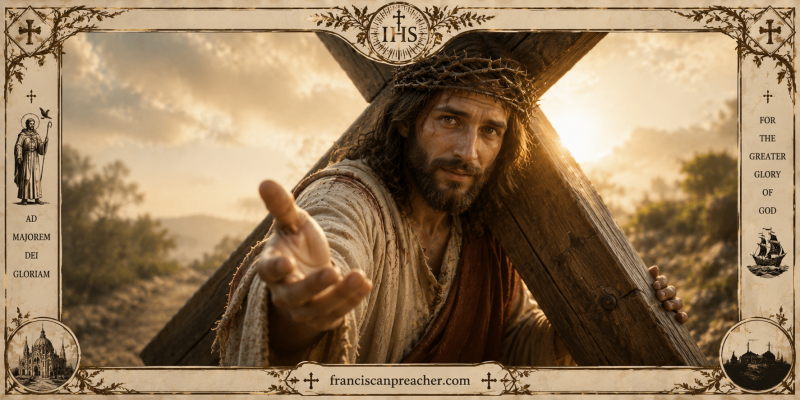
Jesus is not asking us to hate our families. In biblical language, He is teaching that our love for Him must be so absolute that every other attachment becomes secondary.
This was exactly Ignatius's experience.
And it could be ours.
Jesus concludes in today's Gospel: "Every one of you who does not renounce all his possessions cannot be my disciple." (Luke 14:33)
Notice that Jesus does not merely ask us to possess less.
He asks that nothing possesses us.
That is a challenge for every Christian, whether priest, religious, or layperson.
We may not be called to material poverty like Saint Francis, nor to become Jesuit missionaries like Ignatius.
But every single one of us, as disciples, is called to interior freedom.
The freedom to place Christ before career, possessions, reputation, comfort, or even our own plans.
Like both Saint Francis and Saint Ignatius, may we discover that when we surrender everything to Christ, we lose nothing of lasting value and gain everything that truly matters.
Jesus, our God, and our all.
In the name of the Father, and of the Son, and of the Holy Spirit. Amen.
Lectionary: 609
Below are the readings suggested for today's Memorial. However, readings for the Memorial may also be taken from the Common of Pastors, #719-724, or the Common of Holy Men and Women: For Religious, #737-742.
Reading 1
Brothers and sisters:
Whether you eat or drink, or whatever you do,
do everything for the glory of God.
Avoid giving offense, whether to Jews or Greeks
or the Church of God,
just as I try to please everyone in every way,
not seeking my own benefit but that of the many,
that they may be saved.
Be imitators of me, as I am of Christ.
Responsorial Psalm
R. (2) I will bless the Lord at all times.
or:
R. (9) Taste and see the goodness of the Lord.
I will bless the LORD at all times;
his praise shall be ever in my mouth.
Let my soul glory in the LORD;
the lowly will hear me and be glad.
R. I will bless the Lord at all times.
or:
R. Taste and see the goodness of the Lord.
Glorify the LORD with me,
let us together extol his name.
I sought the LORD, and he answered me
and delivered me from all my fears.
R. I will bless the Lord at all times.
or:
R. Taste and see the goodness of the Lord.
Look to him that you may be radiant with joy,
and your faces may not blush with shame.
When the poor one called out, the LORD heard,
and from all his distress he saved him.
R. I will bless the Lord at all times.
or:
R. Taste and see the goodness of the Lord.
The angel of the LORD encamps
around those who fear him, and delivers them.
Taste and see how good the LORD is;
blessed the man who takes refuge in him.
R. I will bless the Lord at all times.
or:
R. Taste and see the goodness of the Lord.
Fear the LORD, you his holy ones,
for nought is lacking to those who fear him.
The great grow poor and hungry;
but those who seek the LORD want for no good thing.
R. I will bless the Lord at all times.
or:
R. Taste and see the goodness of the Lord.
Alleluia
R. Alleluia, alleluia.
Blessed are the poor in spirit,
for theirs is the Kingdom of heaven.
R. Alleluia, alleluia.
Gospel
Great crowds were traveling with Jesus,
and he turned and addressed them,
"If anyone comes to me without hating his father and mother,
wife and children, brothers and sisters,
and even his own life,
he cannot be my disciple.
Whoever does not carry his own cross and come after me
cannot be my disciple.
Which of you wishing to construct a tower
does not first sit down and calculate the cost
to see if there is enough for its completion?
Otherwise, after laying the foundation
and finding himself unable to finish the work
the onlookers should laugh at him and say,
'This one began to build but did not have the resources to finish.'
Or what king marching into battle would not first sit down
and decide whether with ten thousand troops
he can successfully oppose another king
advancing upon him with twenty thousand troops?
But if not, while he is still far away,
he will send a delegation to ask for peace terms.
In the same way,
everyone of you who does not renounce all his possessions
cannot be my disciple."
Add comment
Comments