My dear brothers and sisters in Christ, peace be with you. In today's Liturgy of the Word, we will examine how God never stops sowing His Word. But the fruit of that seed depends upon the condition of our hearts.

In the first reading from the Book of the Prophet Jeremiah, God calls a rebellious people back home. A little background helps us to appreciate the tenderness of this passage. Today, Jeremiah prophesied during one of the darkest periods in Israel's history, the late seventh and early sixth century before Christ. The kingdom had fallen into grievous idolatry, political compromise, and spiritual infidelity. Throughout the opening chapters of Jeremiah, Israel is portrayed as an unfaithful spouse who has abandoned the Lord. Yet today's first reading is remarkable because God does not begin with condemnation, but with an invitation. And I quote: “Return, rebellious children, for I am your master.” (Jeremiah 3:14)
The Hebrew word translated return is shuv, one of the most important words in the Old Testament. Shuv means not simply to come back geographically, but to turn one's whole life back toward God.
Notice that God says: “I will appoint over you shepherds after my own heart.” (Jeremiah 3:15) This is not merely about political leaders. It anticipates God's promise to give His people faithful shepherds, ultimately fulfilled in Christ, the Good Shepherd, and shared in those who shepherd His Church with His heart.
Pope Saint John Paul II began his apostolic exhortation on priestly formation with these very words: “I will give you shepherds after my own heart.” For us as priests and as laity alike, this verse is deeply personal. Apart from the ministerial priesthood, every ordained priest first belonged, like all the faithful of the Church, to the universal priesthood of Christ. God asks us first to have hearts after His own before asking us to shepherd and to look after others.
One of the most fascinating lines is this: “They will no longer say, ‘The ark of the covenant of the Lord.’” (Jeremiah 3:16) This sounds almost shocking. The Ark had been Israel's holiest object. It contained the tablets of the Law, Aaron's rod, and the manna. It represented God's presence among His people.
And yet here Jeremiah is foretelling a day when no one will even speak about it anymore. Why? Not because it has become unimportant, but because something infinitely greater has come: Jesus Christ, born of the Virgin Mary, but who was first housed in her womb. The Old Testament Ark of the Covenant was made out of pure gold. That's nothing in comparison with the pure gold of the immaculate and spotless womb of Mary, which housed God who had become flesh.
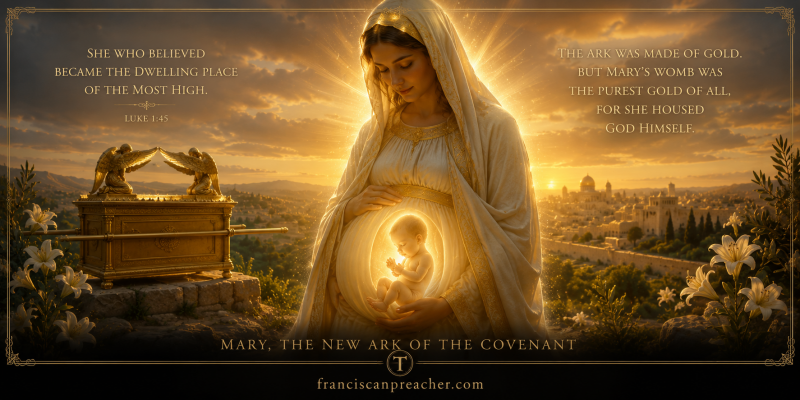
The Catechism says that “The Word became flesh to make us partakers of the divine nature.” (Catechism of the Catholic Church, 460) God's presence is no longer centred upon a golden chest, but upon the living Person of Jesus Christ, who remains with us in the Eucharist and desires to live within our souls and our hearts. As Saint Paul says: “Do you not know that your body is a temple of the Holy Spirit?” (1 Corinthians 6:19)
Now we come to the Gospel.
Many people think today's Gospel is about four kinds of soil. In reality, it's about four responses to exactly the same Word. The seed never changes. The sower never changes. Only the soil changes.
Saint John Chrysostom observes: “The fault lies not with the sower, nor with the seed, but with the ground that receives it.”
Every person in church today has received the same Gospel. We just heard it proclaimed, for example, in today's Mass. Or perhaps we still have to go to Mass and we will hear it. Yet the results will differ because of the condition of each heart.
And that is why I reiterate, my brothers and sisters: look after your heart. Look after your temple, your soul. Look after what is most sacred. Do not throw the gift God has given to you away.
For sure, we need good shepherds. We need pastors who will truly tend our wandering souls. But most of all, we ourselves personally need to respond to the Word of God and to make that soil fertile in which the seed is planted, so that we too, after listening to the Word of God and putting it into action, living it, loving it, embracing it, and sharing it, will bear much fruit for the glory of God, and out of great love and thanksgiving to the God who has given us everything.
Amen.
Add comment
Comments