On this Friday of the 12th Week in Ordinary Time, Year A, we come to readings that are very profound and cause us to reflect and take a while to assimilate the Word of God that we are hearing at Mass today. So let me give you a little bit of background to both readings first.
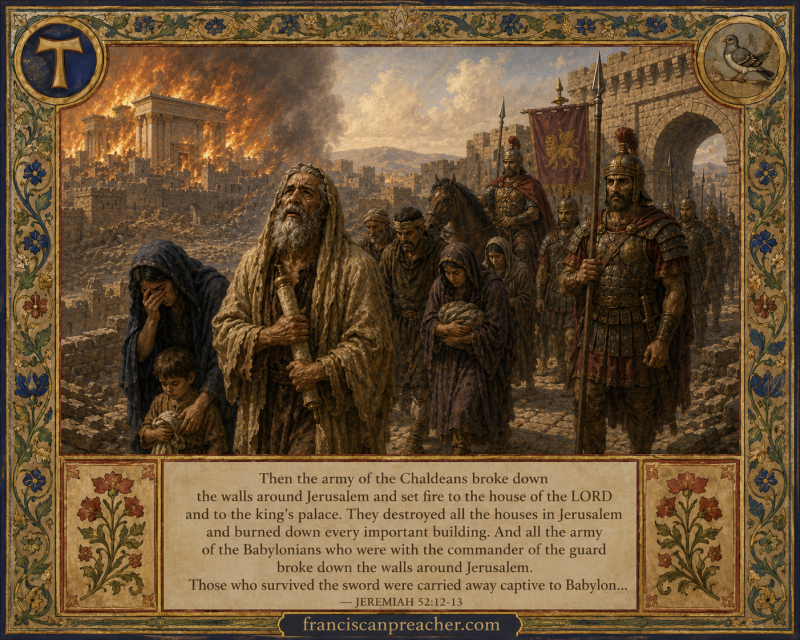
First, we hear from the Second Book of Kings, chapter 25, verses 1–12. This passage records one of the darkest moments in the history of Israel: the fall of Jerusalem in 587/586 BC.
My brothers and sisters, after centuries of repeated warnings from the prophets—prophets like Isaiah, Jeremiah, Ezekiel, Hosea, and Amos—the people and their leaders continually rejected God. They embraced idolatry, worshipping other gods instead of the one true God, and trusted in political alliances rather than the grace of the Lord.
King Zedekiah rebelled against Babylon despite the repeated counsel of the prophet Jeremiah to surrender and repent. After an eighteen-month siege, famine devastated the city. Jerusalem fell. The Temple built by Solomon was burned to the ground, and much of the population was taken into exile.
Yet, my brothers and sisters, even in this terrible judgment that is happening before their eyes, God's covenant was not destroyed. The exile would become a period of purification and eventually restoration.
Then, in the Gospel, we hear that immediately after completing the Sermon on the Mount, Jesus begins to demonstrate in action the authority with which he has just taught the people. He performs the first miracle recorded by Saint Matthew, and that miracle was the cleansing of a leper, a person who was not only physically diseased but also ceremonially unclean and socially isolated because of the laws written in Leviticus.
By touching the leper, Jesus does not become unclean. Rather, his holiness overcomes the uncleanness, and he then instructs the healed man to go and present himself to the priest, just as he did with the other ten lepers that we hear about who were healed all at once. He sent them on their way to present themselves to the priest. Only with them, he gave them this instruction before he healed them, for they were healed on their way. This one particular leper is healed and then asked to go and present himself, not because the priest heals him, but because the Law required priestly verification of healing. Jesus therefore shows both his divine authority and his respect for the Law he came to fulfil.
My brothers and sisters, in these readings we see how sin always destroys. God does not warn us in vain.
The destruction of Jerusalem did not happen overnight. “The siege of the city continued until the eleventh year of Zedekiah.” We are told in the reading that this tragedy had been centuries in the making. For centuries God had sent prophet after prophet. He warned, he pleaded, he called his people back, but they would not listen.
The burning of the Temple was not God abandoning his people, but rather it was the inevitable consequence of generations who abandoned him first.
This is a lesson for us, my brothers and sisters. How small compromises become great disasters. How sin always promises freedom but ultimately leads to slavery.
God corrects us because he loves us. Sometimes that love can seem very tough, but it is often the most real, the most profound, and the most life-changing.
Even after judgment, God never forgets mercy.
The final verse of this reading seems almost insignificant, but it is very important. “Some of the country’s poor were left behind as vinedressers and farmers.” This is a sign to the people that gave them hope. God always preserves a remnant. He never destroys everything. Even in punishment, there remains mercy. When he flooded the world, he preserved Noah on the ark. Even in exile, there remains hope. When our lives seem broken beyond repair, God is already preparing restoration. Sometimes he has to break us down in order to build us back up.
My brothers and sisters, in the Gospel we see how faith begins with humility.
The leper says to Jesus, “Lord, if you wish, you can make me clean.”
Notice what he does not say. He does not demand. He does not bargain with the Lord. He simply entrusts himself to Jesus. He has complete confidence in Christ's power while humbly submitting to his will.
“If you wish, Lord, you can make me clean.”
That is an authentic model for us of what prayer should look like—not, “Lord, do what I want,” but, “Lord, your will be done.”
Jesus is willing.
Perhaps these are the most beautiful words in today's Gospel, and there are only four words:
“I will do it.”
The leper has complete confidence in Christ's power while humbly entrusting himself to his will. Jesus never questions his own mercy. Whenever we sincerely repent, Christ's answer is always the same: I will. I forgive. I cleanse. I restore. I bring back to life.
The Cross is the permanent proof that Christ wills our salvation.
My brothers and sisters, what warnings might the Lord be sending each and every one of us to change our own ways before we too are swept into slavery—different forms of slavery? There can be the slavery of depression, the slavery of economic demise, the slavery of emotional attachment to one particular person, an unhealthy relationship. There are many forms of slavery and addictions.
Let us turn to the Lord who restores us, liberates us, and heals us.
May he be praised forever.
In the name of the Father, and of the Son, and of the Holy Spirit. Amen.
Add comment
Comments